Design Technology
Why Prototypes Lie
The gap between what a prototype communicates and what gets built
Feb 2026 · 8 min
The prototype looked perfect.
Clean layout. Smooth transitions. Every number formatted correctly, every label fitting neatly inside its container. The stakeholder leaned forward, nodded slowly, and said the words every project team is waiting for:
"Yes. That's exactly what we need."
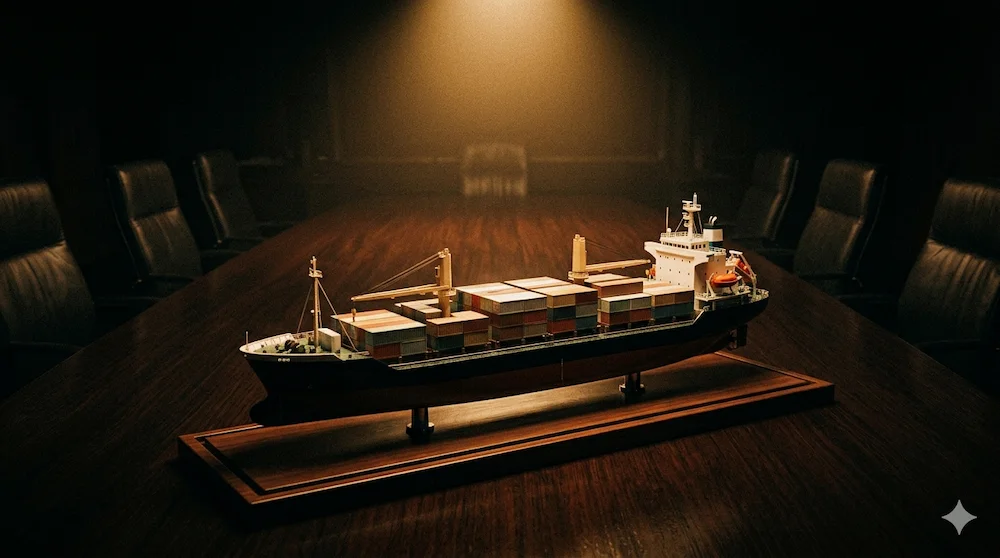
Six months later, the product that shipped looked like the prototype the way a working vessel looks like the scale model in the boardroom. The proportions were roughly right. The intention was visible. But the model had no plumbing, no load calculations, no rust — and nobody had thought to mention that while the client was nodding. The model was built for the boardroom. The vessel has to survive the North Sea.
This is not a story about a bad project. It is a story about what prototypes are actually for — and why that purpose and the one we pretend they serve have almost nothing in common.
A prototype is not a design. It is not a specification. It is not a commitment.
It is a persuasion tool dressed as a design tool — optimised for the moment of approval, not the moment of delivery. Everything about how prototypes are built serves that moment: the happy path, the ideal content, the interaction that flows because nobody has introduced reality.
real data, a real user, a real edge case.
The gap between prototype and product has always been expensive. Teams have always known this and absorbed the cost anyway — because the alternative, building to production fidelity just to prove a concept, was more expensive still. The prototype was a rational approximation. A fiction everyone agreed to believe because the truth cost too much to tell.
That cost calculation has changed. And with it, the excuse.
What a Prototype Actually Is
A prototype is not a design. It is a communication tool optimised for a specific audience at a specific moment: the stakeholder who needs to approve before the team can proceed.
Everything about how prototypes are constructed serves that moment. The happy path is shown because the happy path is the most convincing. Ideal content is used because ideal content fits. Transitions are smooth because the tools that produce them make smoothness free. Edge cases are absent because edge cases are unconvincing in a presentation and expensive to prototype.
This is not cynical. It is rational. The prototype exists to unlock the next phase of work. Optimising it for approval is optimising it for its actual purpose.
The problem is not that prototypes are persuasion tools. The problem is that everyone downstream — developers, QA, content designers, accessibility engineers — has to build the truth from a fiction. And this fiction rarely comes with a label that says what it left out.
A prototype is a lie your client agreed to believe. The problem is your engineers have to build the truth.
The Specific Lies
Every prototype lies in the same directions. The specific details change by project. The categories don't.
Content failureThe prototype was built with ideal content. Short names. Round numbers. One line of body copy per card. Real data has a 47-character vessel name that breaks the layout at the fold. Real data has a null state nobody designed. Real data has a number so large it pushes the label off the edge of its container. The prototype never met any of these because the person who built it was designing for approval, not for reality. Content failure is the most common prototype lie and the cheapest to find — if anyone thinks to look for it before handoff.
To be fair, I have met good designers who stress test their designs with extremely long data. However, often they are still assumptions and not verified by what real data looks like.
Edge casesThe happy path is not the product. It is the best possible version of the product under ideal conditions with a cooperative user who does exactly what the prototype assumed they would do. Real users don't read labels. They arrive mid-flow. They go backwards. They submit empty forms. They have accounts in states the prototype never modelled. The prototype showed one path through a product that has hundreds. The team built confidence from a sample size of one.
Motion costThe transition looked effortless in the prototype. Smooth, considered, exactly right. Nobody mentioned that the component it implied doesn't animate that way natively, that achieving it requires a custom implementation, and that the custom implementation will take three weeks and introduce a regression in the component it shares state with. Motion is the most consistently undercosted element in any prototype because the tools that produce it make it free. Production never does.
Technical constraintsThe prototype implied a component that doesn't exist in the design system. It implied a data relationship the API doesn't support. It implied a real-time update the infrastructure wasn't built for. None of these were visible in the prototype because prototypes don't have backends. The stakeholder approved something the architecture couldn't deliver without significant additional work — work that wasn't scoped because nobody knew it was needed until development started.
Sometimes this is ok, if the product's scope includes being a forcing function to evolve architecture and data relationships.
AccessibilityNobody prototypes a screen reader experience. Nobody prototypes keyboard navigation. Nobody prototypes a colour-blind user's path through the interface. Accessibility is the lie of omission — not a deliberate deception but a systematic absence. The prototype showed the interface to one type of user under one set of conditions. And yet, the product has to work for everyone.
The "quick and dirty" prototype — a special caseSome teams reach for a working proof of concept instead of a Figma prototype, believing that code closes the gap. It closes some of it. The motion lie disappears — at least what you see is physically achievable. But most of the other lies persist. The happy path problem persists. The content failure problem persists. The edge case problem persists. A POC is optimised for proving technical feasibility, not user truth. It shows that something can be built; there is little value in proving the already known fact that pretty anything can be built these days. It rarely shows whether it should be built the way it's being shown.
And it introduces a risk the Figma prototype never carries.
Quick and dirty code has a way of becoming the foundation. "We'll refactor it properly once we've validated the concept" is the most expensive sentence in software development — not because the sentiment is wrong but because the mandate to refactor rarely arrives. The POC that proved the concept becomes the codebase the team is still working around three years later. The Figma prototype was thrown away after the presentation. The POC became the product.
The prototype lied about the experience.
The POC lied about the architecture.
Both debts compound.
Why We Accepted the Lie
The prototype was a rational response to a real constraint.
Building to production fidelity to validate a concept used to cost weeks. A team that wanted to test whether a dashboard layout would work for its users had two options: spend a day in Figma and present something convincing, or spend three weeks in code and present something real. The Figma option won every time — not because anyone was being dishonest, but because the economics were overwhelming.
The fiction was cheaper than the truth. Everyone knew it was fiction. The convention held because both sides — designers and developers — understood the gap and managed it through handoff rituals, QA processes, and the kind of institutional knowledge that lives in the heads of senior engineers who have seen this before.
The system worked, after a fashion. The debt was real but it was predictable. Teams learned to read prototypes the way experienced translators read approximations — extracting the intent, discarding the literal, building the gap into their estimates.
That translation layer is now obsolete.
AI Has Changed the Cost Calculation
The tools have moved.
A technical designer with access to v0, Cursor, or Claude can produce a working coded interface with real data, real content, and real edge cases in a day. Not a polished production application — but something significantly closer to the truth than a Figma prototype, at a cost that is now comparable to building the Figma prototype in the first place.
The motion is real. The content failures surface immediately. The edge cases are visible before the stakeholder meeting. The technical constraints are discovered during the build, not after the approval.
This does not make prototyping obsolete. It makes the excuse obsolete.
The gap between prototype and product was always a choice dressed as a constraint. The constraint was real — it used to cost too much to close. It no longer does. Which means teams that continue to present persuasion-optimised fiction as a design artefact are now making that choice deliberately, with full knowledge of what it costs downstream.
That is a different kind of dishonesty than the one we normalised.
What Honest Prototyping Looks Like
The answer is not to abolish prototypes. It is to be explicit about what each prototype is for — and what it is not.
Exploration prototypes are for the team, not the client. They are thinking tools — disposable by design, never intended to survive contact with a stakeholder. Treat them as such. Never present an exploration prototype as a design decision. It is a question, not an answer.
Approval prototypes should be accompanied by an explicit fidelity declaration: here is what this prototype shows, and here is the specific list of what it does not show. Content has been idealised. Edge cases have not been tested. Motion costs have not been assessed. Accessibility has not been considered. This list is not a caveat — it is the scope of the next phase of work. Making it explicit converts the fiction from a liability into a brief.
Production prototypes — working code with real data, real content, and real constraints — should now be the default for anything that will inform architectural decisions. AI makes this viable at a cost that was unthinkable three years ago. For the categories of work where the prototype has historically caused the most downstream damage — complex data interfaces, real-time systems, anything with significant state management — the production prototype is no longer a luxury. It is the responsible choice.
The Lie We Chose to Keep Telling
The prototype was always a fiction. The team knew it. The experienced developers knew it. The senior designers knew it. The clients mostly didn't — and the convention held because the economics made honesty impractical.
The economics have changed.
The question AI forces on every team that still reaches for a Figma file when a working prototype is now a day's work is a simple one: why?
If the answer is speed — that calculation needs revisiting.
If the answer is client expectation — that is a conversation worth having, and the tools now exist to have it with evidence rather than approximation.
If the answer is habit — that is the most honest answer, and the most expensive one.
The prototype that your client agreed to believe no longer has to be a lie. The teams that keep telling it anyway have stopped doing so out of necessity. They are doing it by choice.
That choice has a cost. It always did. Now there is less excuse for not seeing it.
The right problem.
The right partnership.
Open to the right full-time leadership roles and consulting partnerships. If the problem sits at the intersection of design, data, and technology — let's talk.